
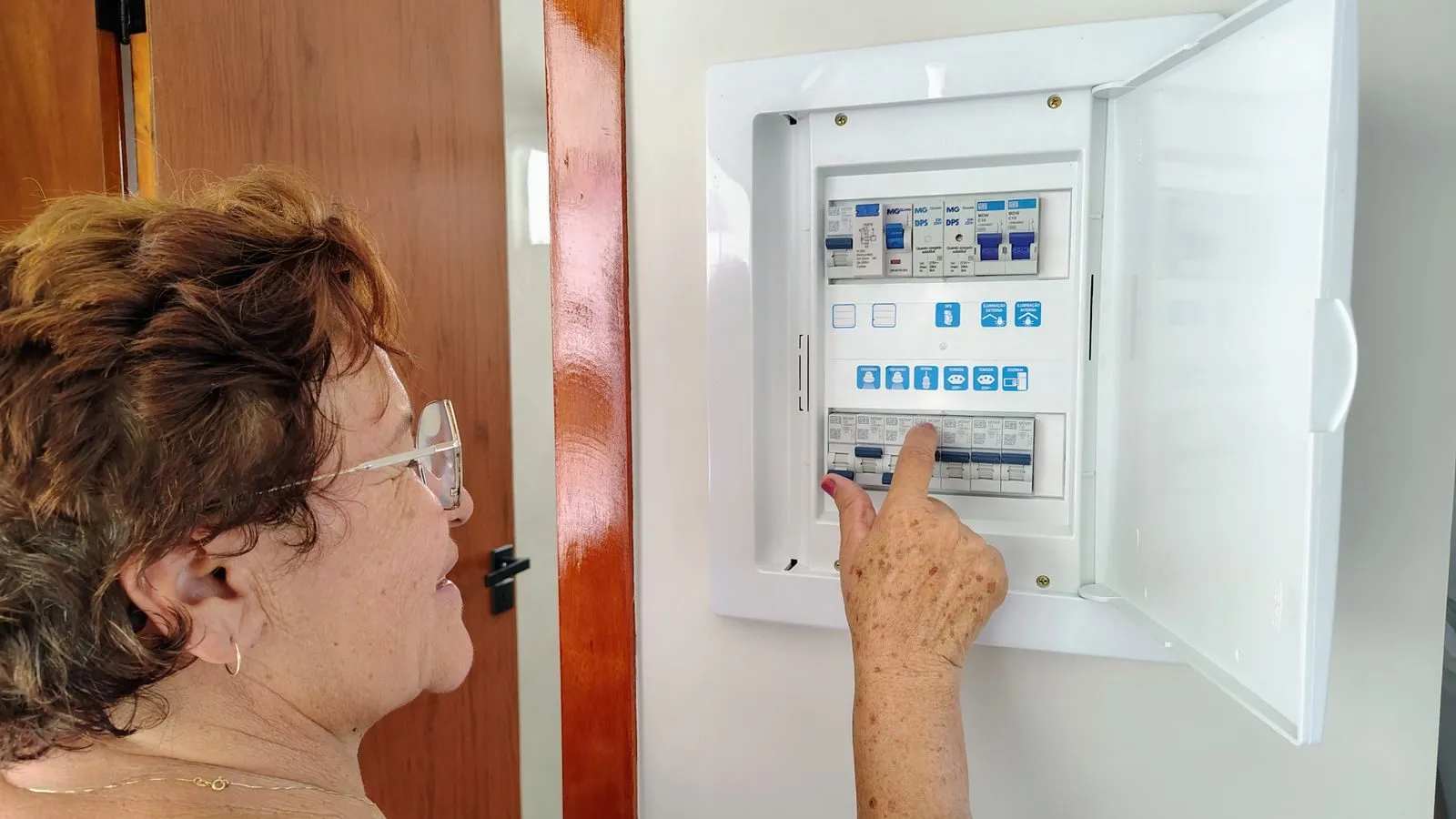
A breaker that won't reset is the panel telling you something is still wrong on that circuit. The first cold week of fall is when we see it most. Space heaters come out, the oven runs all afternoon, and a breaker that has been fine all summer starts to snap back or refuse to stay on.
This guide is for the breaker that is stuck in the middle, flips straight back off, or goes limp when you push it. It covers the checks you can safely do, what each result means, and when to stop and call.
First, Make Sure It Is Really Tripped
A tripped breaker usually sits in the middle, somewhere between ON and OFF. Some are marked with a small colored flag. A breaker that looks fully ON but the power is dead is a different problem, and it is worth a call.
Open the panel door only. The metal cover behind it has live parts underneath, and it stays on. You are only touching the plastic handles. If the floor around the panel is wet, or you are standing in water, stop and call us instead.
How to Reset a Tripped Breaker the Right Way
Most breakers will not latch if you only push them toward ON. They have to go all the way to OFF first, then back to ON. Here is the order we would walk you through over the phone:
- Unplug everything on that circuit and turn off the lights and switches that feed it.
- Push the handle firmly to OFF until it clicks.
- Push it firmly to ON with a steady motion, and stand a little to the side of the panel while you do.
- If it holds, plug things back in one at a time, a minute apart.
If it holds with nothing plugged in and trips again when one particular thing goes back in, you have found your overload or a bad appliance. That is the good outcome.
What It Means When a Breaker Won't Reset
How the breaker behaves tells us a lot. Here are the usual results and what each one points to.
It Trips Again Right Away With Everything Unplugged
A breaker that kicks back the instant you turn it on, with nothing in use, usually means a short or a fault somewhere in the wiring or in a device that is hardwired into that circuit. Do not keep trying. Leave it off and have it looked at.
It Holds for a While, Then Trips With a Heavy Load
That is a classic overload. The circuit has more on it than it can carry. Move the heater or the kitchen appliance to a different circuit and see if it settles. If the same thing keeps happening, the circuit may need to be split up or a dedicated circuit added.
It Will Not Latch at All, or Feels Loose
If the handle flops or will not stay in the ON position, the breaker itself may be worn out. Breakers are mechanical parts, and they do wear. This is not a homeowner fix, and you should not pull a breaker out to look at it.
It Is Warm, Buzzing, or Smells Like Burning
Stop. Leave that breaker off, keep your hands off the panel, and call us. Heat, buzzing, a burning smell, or discolored plastic mean something is overheating. That is not a wait-until-Monday problem.
The Breaker Is Fine but an Outlet Will Not Reset
A GFCI outlet may be the part that tripped, and the panel was never the problem. Our guide on a GFCI outlet that won't reset covers that. Bathrooms, garages, kitchens, and outdoor outlets are the usual places.
Heating Season Is Overload Season
When the weather turns, a lot of the load in a house shifts to a handful of circuits. A space heater is one of the heaviest things you can plug into a normal outlet. Put it on the same circuit as a TV, a lamp, and a charger, and the breaker has every reason to trip.
Plug heaters directly into the wall, not into a power strip or a thin extension cord. Give them a circuit to themselves where you can. If you keep tripping the same breaker every time the cold snap hits, that tells you the circuit is too busy for how you live now. It is useful information, not bad luck.
Why You Should Not Keep Flipping It
It is tempting to keep trying. Please don't. A breaker that keeps tripping is doing its job. Forcing it back on over and over asks the wiring to carry a load or a fault it was never meant to carry, and it wears the breaker too.
Once or twice to rule out a random trip is fine. Three tries on the same breaker is our rule of thumb. If you want to understand what is behind the trips, read why a breaker trips in the first place. This page is about what to do when it will not reset at all.
The Panel Itself Can Be the Problem
Sometimes the breaker is not the weak link. Older panels, especially Federal Pacific Stab-Lok panels, are known for breakers that may not trip when they should. If your panel is old and you are having breaker trouble, read about Federal Pacific panels and Stab-Lok breakers.
A panel that is full, crowded, or simply too small for today's loads can also cause repeated trouble. Homes in Orchards and Hazel Dell were wired for a lot less than we plug in now. When a heat pump, an EV charger, and a space heater all land on the same service, an electrical panel upgrade is sometimes the real fix.
What to Tell Us When You Call
A few details make the first visit go faster. Tell us which breaker it is and what is on it, whether it trips right away or after a while, and what was running when it started. If the panel door is labeled, read us the label. If it is not, a photo of the panel door helps.
Also tell us if anything changed recently: a new appliance, a remodel, a storm, or a power flicker. You do not need to diagnose it. We just want the story, because it saves time once we are standing at the panel.
When to Call an Electrician
Call us if the breaker will not stay on, if it trips with nothing plugged in, if it feels hot, or if more than one breaker is acting up. Also call if you smell burning near the panel or cannot tell which circuit is the problem.
For a no-power or burning-smell situation, use our emergency electrician line. We answer 24/7, and that includes weekends and holidays. Breaker tripped at 9 p.m.? We've gotten that call. Ryan has turned his truck around on the way home to go fix one.
For a breaker that is a nuisance but not an emergency, our electrical repair service in Vancouver, WA is the place to start. Our published service call is $225 and covers the first hour on site, which includes diagnosing the problem. You can see how that works on our pricing page.
Always confirm that whoever shows up is licensed. You can check any Washington electrical contractor on the L&I license verification page. Ours is NEWMAEL798DR.
Breaker won't reset in Vancouver, Camas, Battle Ground, or anywhere in Clark or Cowlitz County? Call 360-828-7143, or send us the details and we will get back to you.